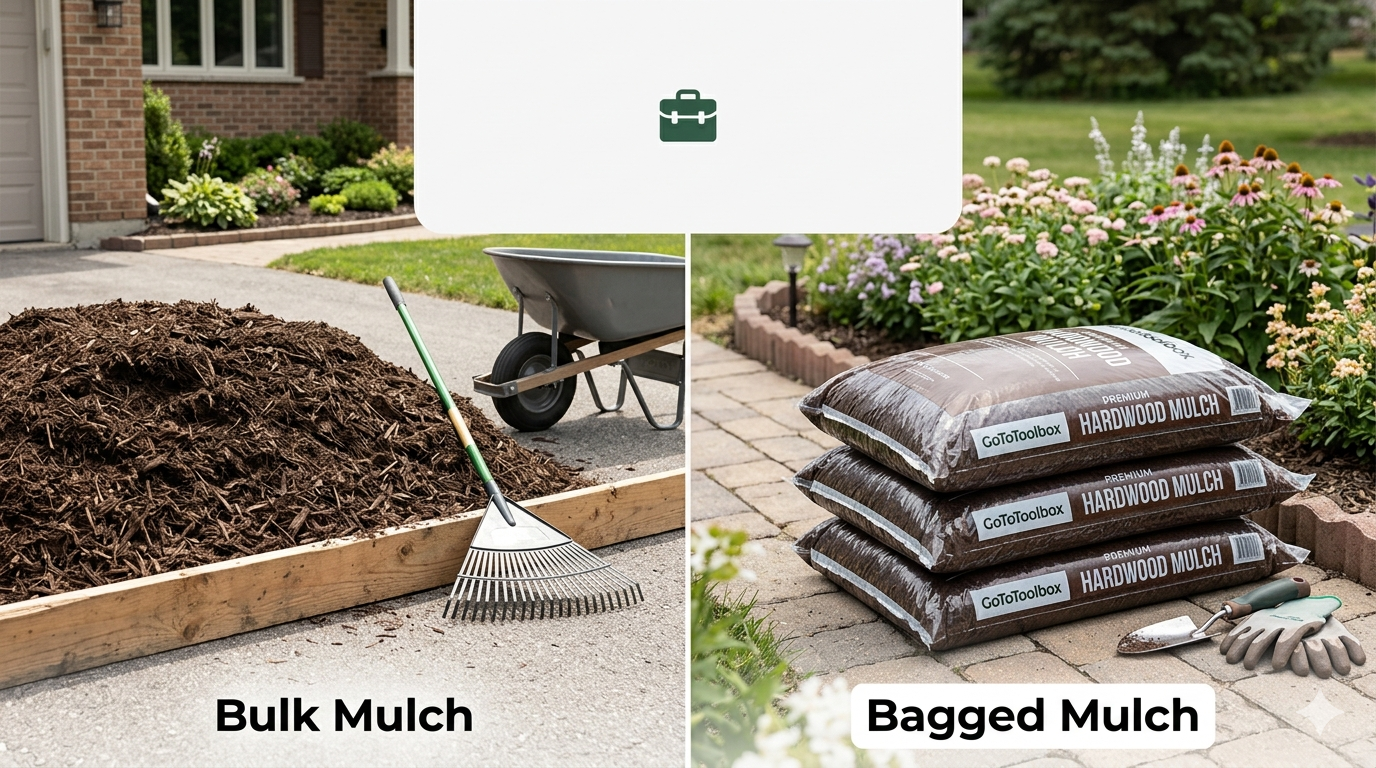
If you have used our Mulch Calculator and discovered that your project requires more than a few hundred square feet of coverage, you are likely facing the classic landscaper’s dilemma: Bulk Mulch vs Bagged Mulch, which one should you choose?
At first glance, bags seem convenient, while bulk seems professional. However, the “real” answer to the Bulk Mulch vs Bagged Mulch debate depends on a technical intersection of volume math, delivery logistics, and material longevity. In this guide, we break down the hard data so you can make the most cost-effective decision for your garden.
The Math: How Many Bags Equal a Cubic Yard?
Before comparing prices, you must understand the volume conversion. Most garden centers sell mulch in 2-cubic-foot bags. Most bulk suppliers sell mulch by the cubic yard.
1 Cubic Yard = 27 Cubic Feet.
Therefore, it takes 13.5 bags (of the 2cu ft size) to equal just one single cubic yard of bulk mulch.
If our calculator told you that you need 5 cubic yards, you are looking at hauling and opening 68 bags. This is the primary “labor cost” that many homeowners forget to calculate.
The Financial Math: Bulk Mulch vs Bagged Mulch Cost
Before comparing prices, you must understand the volume conversion. Most garden centers sell mulch in 2-cubic-foot bags, whereas bulk suppliers sell by the cubic yard.
When analyzing Bulk Mulch vs Bagged Mulch pricing, remember:
1 Cubic Yard = 27 Cubic Feet.
It takes 13.5 bags (2cu ft) to equal just one single cubic yard.
If you need 5 cubic yards, you are looking at hauling 68 bags. This is the primary labor factor that tilts the Bulk Mulch vs Bagged Mulch comparison toward bulk for large projects.
The Price Breakdown
Bagged Mulch: Average $3–$6 per bag ($40–$81 per yard).
Bulk Mulch: Average $15–$35 per cubic yard (plus delivery).
The “Hidden” Variable: Delivery Fees
While bulk mulch is cheaper, it rarely arrives for free. Local nurseries typically charge a flat delivery fee ranging from $50 to $150.
The Tipping Point: If you only need 1 or 2 yards, the delivery fee makes bulk more expensive than bags.
The Sweet Spot: Once your project requires 4 cubic yards or more, bulk becomes the undisputed financial winner, even with the delivery fee included.
Quality and Freshness: Bulk Mulch vs Bagged Mulch Quality
It isn’t just about the money; it’s about the health of your soil. In the Bulk Mulch vs Bagged Mulch quality check, bulk often wins on freshness. Bagged mulch can sit in plastic for months, leading to “sour mulch” (anaerobic conditions). Fresh bulk mulch usually has better nutrient return for your plants.
The Bagged Advantage: Sterility
Bagged mulch is often processed at higher temperatures and sealed, meaning it is less likely to contain weed seeds or local pests. It is also easier to transport if you have a small sedan rather than a pickup truck.
The Bulk Advantage: Freshness
Bulk mulch is often “fresher.” Bagged mulch can sit in plastic for months, leading to anaerobic conditions (sour mulch). Fresh bulk mulch has a better smell and often contains more beneficial fungal activity that helps your plants thrive.
The Labor Factor: Time is Money
When deciding between bulk and bags, ask yourself: How much is your afternoon worth?
Bags: You can move them one by one. You can place the bags exactly where you need them before opening. Cleanup is just a pile of plastic film.
Bulk: A dump truck will leave a massive mountain in your driveway. You will need a wheelbarrow, a pitchfork, and several hours of heavy lifting to move that material to the backyard.
Specialized Scenarios: When to Choose Which?
Choose Bagged Mulch If:
Small Spaces: You are only mulching a few isolated pots or a tiny 4×4 raised bed.
Color Matching: You need a very specific “Electric Cyan” or “Deep Red” dyed mulch that nurseries might not stock in bulk.
No Driveway Space: You live in an urban area where a dump truck cannot safely leave a pile of wood chips.
Choose Bulk Mulch If:
Large Scale: You are covering the entire perimeter of your home.
Budget Priority: You want to save 40-60% on material costs.
Soil Improvement: You are using organic, undyed chips to build long-term soil health.
How to Use GoToToolbox to Save Money
To avoid “over-buying,” which is the biggest waste of money in landscaping, follow this workflow:
Measure Twice: Measure the length and width of your beds.
Calculate Depth: For weed suppression, 3 inches is standard. For refreshing old mulch, 1-2 inches is enough.
Run the Numbers: Input your data into our Mulch Calculator.
The “Bag Check”: If the result is over 100 cubic feet, stop buying bags. Call a local yard and ask for a bulk quote.
Summary Table: Bulk Mulch vs. Bagged Mulch At-A-Glance
| Feature | Bulk Mulch | Bagged Mulch |
| Cost per Yard | $15 – $35 | $40 – $80 |
| Delivery | Required ($50-$150) | DIY (Personal Vehicle) |
| Labor | High (Shoveling/Wheelbarrow) | Moderate (Lifting/Carrying) |
| Quality | Natural/Fresh | Uniform/Sterilized |
| Best For | Large landscapes (> 4 yards) | Small beds & touch-ups |
Frequently Asked Questions (FAQ)
Q: How many bags of mulch equal 1 cubic yard?
A: If you are using standard 2-cubic-foot bags, it takes 13.5 bags to equal 1 cubic yard. For 1.5-cubic-foot bags, you will need 18 bags, and for 3-cubic-foot bags, it takes 9 bags. You can use our Mulch Calculator to convert your total square footage into the exact number of bags required.
Q: Is bulk mulch better quality than bagged mulch?
A: Generally, yes. Bulk mulch is often “fresher” because it hasn’t been sitting in a sealed plastic bag, which can cause anaerobic (sour) conditions. Bulk mulch also tends to be shredded more consistently and provides better nutrient return to the soil as it breaks down naturally.
Q: Does bulk mulch contain weed seeds?
A: Most professional nurseries and landscape suppliers use “clean” wood sources, but there is always a small risk of weed seeds if the mulch was stored near open fields. However, the 3-inch layer of mulch itself is designed to suppress existing weeds by blocking sunlight, so the benefits far outweigh the risks.
Q: Can I transport 1 cubic yard of mulch in my car?
A: A single cubic yard of mulch weighs between 400 and 800 pounds and takes up 27 cubic feet of space. Most standard SUVs and cars do not have the volume or weight capacity to carry bulk mulch safely. For anything over half a yard, a pickup truck or professional delivery is highly recommended.
Q: How long does the color last in bulk vs. bagged mulch?
A: High-quality bulk dyed mulch often holds its color longer (up to 12 months) than bagged mulch, which can fade quickly once the plastic is opened and the material is exposed to UV rays. For the best results, avoid laying dyed mulch right before a heavy rainstorm to allow the dye to “set” into the wood.
Conclusion: Making Your Decision
There is no “lie” in the math: Bulk mulch is the superior choice for large-scale landscaping and long-term soil health. However, for the weekend warrior with a single raised bed, the convenience of a few bags from the local garden center cannot be beaten.
Before you head to the store, ensure you have the exact numbers. Use our Soil Calculator if you are filling new beds, or stick to the Mulch Calculator for surface coverage.
Precision planning is the difference between a beautiful garden and a wasted budget.